IBS Paris 2026
14-15 OctoberParis, France
EXPO
Everything you’ll ever need to manage your IoT connectivity
You are #1 We are Tele2

We are very proud to be ranked #37 in TIME's World's Most Sustainable Companies

Last update
July 27, 2026
Published
July 24, 2026
The highest-stakes IoT deployments aren’t in smart cities — they’re keeping water flowing in places without reliable electricity, powering smart water management through the same sustainable connectivity Tele2 IoT builds every day.
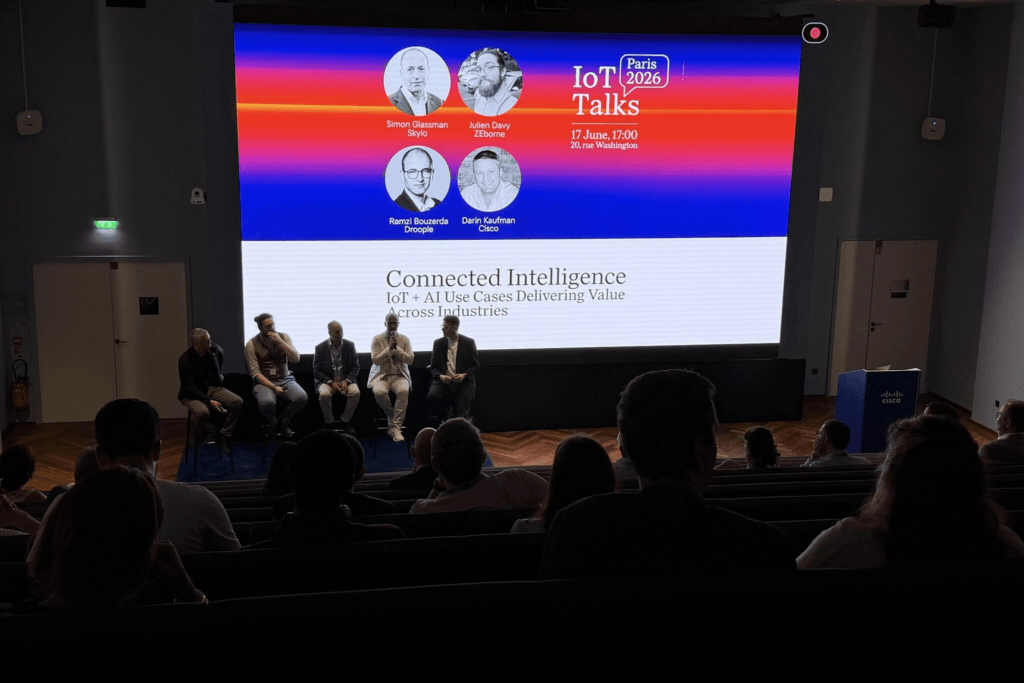
There is a line from the Tele2 IoT Talks Paris event in June 2026 that has stayed with us. Ramzi Bouzerda, founder and CEO of Droople — a Swiss-based IoT and AI platform for water infrastructure with over 100 clients across 20 countries and a Tele2 IoT connectivity partner said it simply:
“IoT and AI will eat the world, but we still need the fork to eat. We still need water, we still need energy, we still need food to sustain life.”
It is a useful correction to the direction most industry conversations travel. The dominant narrative around IoT right now is robots, smart cities, autonomous vehicles, and AI-native infrastructure. All of it is real and important.
But the applications that carry the highest stakes — where a connectivity failure is not a business inconvenience but a public health event — are often the ones that receive the least attention. Droople’s water-monitoring platform runs on Tele2 IoT connectivity, and water is the kind of problem that puts sustainability commitments to the test.
Tele2 was recently ranked #22 on TIME’s World’s Most Sustainable Companies list of 2026 — and a reliably connected borehole in Gambia is what that ranking looks like on the ground: a mining site that stays operational, a community that knows its water is safe and a network built to keep working under difficult conditions.
Water infrastructure globally is in a worse state than most technology conversations acknowledge. Ageing pipes, inadequate monitoring, inconsistent treatment quality, and poor visibility into system performance are problems that affect not just developing regions but cities across Europe and North America.
And they compound as climate pressure makes water scarcity a sustainability issue everywhere. The difference is that in remote or resource-constrained areas, the consequences of a monitoring gap are immediate and severe.
Droople’s deployments illustrate the range. Mining operations in Australia and Africa, where potable water for workers in remote sites is a legal and operational requirement: if the water supply fails, the workers cannot be on site; if the workers cannot be on site, the mining stops.
The infrastructure sits in areas where water is already scarce and frequently polluted, requiring active treatment monitoring to remain safe.
A monitoring device installed on a borehole in rural Gambia cannot be designed around a single network technology. It may connect via LoRaWAN in one location, LTE-M where cellular coverage exists, and satellite where neither is available.
The connectivity platform managing that device needs to handle those transitions without manual intervention, and the data connection needs to be reliable enough that a gap in water quality monitoring does not go undetected.
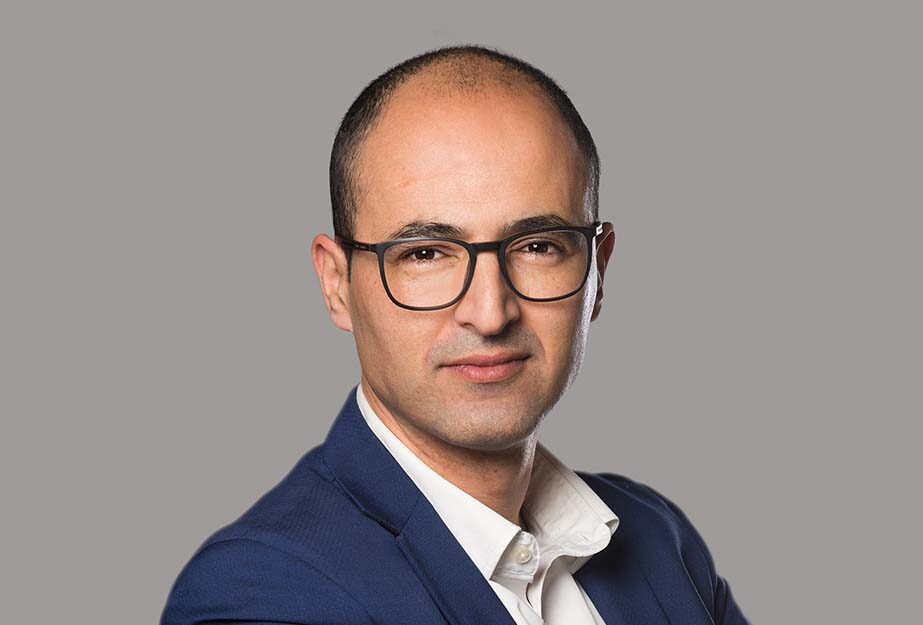
We are in places — in basements, in rural areas — where you need to connect boreholes in Gambia or Burkina Faso or Southeast Asia. You never know what kind of connectivity you will get. The agility to switch from LoRaWAN to LTE-M to satellite is very important to ensure reliability for our customers.
From a Tele2 IoT perspective, this is a precise description of what managed connectivity needs to mean in practice. Multi-technology SIM management — the ability to switch connectivity technology based on what is available at a given location without requiring manual configuration — is not a product feature in these deployments. It is the difference between a working system and a gap in coverage with real consequences.
The role of AI in water infrastructure is still early but directionally clear. Bouzerda described the most valuable near-term application as pattern recognition on low-signal sensor data: detecting the subtle anomalies that precede a system failure, before the failure occurs.
“AI can replicate the instinct of a very experienced worker — someone who, with years of experience, was able to recognise low signals and, even without consciously thinking, make conclusions about what was about to happen. AI can catch every low signal and put out a scenario before it happens, being able to answer it right away,” says Bouzerda.
The architecture Droople is moving toward reflects a broader trend: AI on the edge rather than in the cloud. For water monitoring devices in remote locations, sending raw data to a cloud platform for processing is expensive, latency-prone, and dependent on consistent connectivity.
Running lightweight inference on the device itself — transmitting only meaningful signals rather than continuous data streams — reduces bandwidth requirements, lowers cost and energy use, and makes the system more resilient to the connectivity interruptions that remote deployments have to manage.
One development Bouzerda shared at the Tele2 IoT Talks Paris event points toward a significant expansion of where water monitoring goes next.
Droople is working on a B2C product designed to tell individuals whether their tap water contains concerning levels of heavy metals or PFAS compounds — the class of synthetic chemicals that has become a recurring subject in public health coverage globally.
The product is not yet available, but the direction is deliberate: taking sensing and analysis capability currently deployed for industrial and municipal clients, and making it accessible to individuals who want to make informed decisions about their water.
This signals a direction for IoT at large: industrial-grade monitoring capability, made affordable enough to operate at the individual or household level, connected through the same managed networks that serve enterprise deployments. The infrastructure is the same. The addressable population is orders of magnitude larger.
At Tele2 IoT, much of our focus is on automotive, robotics, and smart city infrastructure — large, fast-growing markets where connectivity architecture decisions carry significant commercial weight. But conversations like the one at the Tele2 IoT Talks Paris event are a useful reminder that the spectrum of meaningful IoT applications runs from the highest-technology use cases to the most fundamental.
A borehole in Gambia that reliably tells a community whether their water is safe to drink requires the same qualities from its connectivity as a connected vehicle on a motorway: reliability, multi-network resilience, low-friction management across borders and network types, and the ability to scale without proportional increases in operational complexity. The stakes are different. The infrastructure requirements are not.
Water will not become less important as the world becomes more connected. If anything, the combination of climate pressure, population growth, and ageing infrastructure makes water monitoring the more urgent application.
Bouzerda’s prediction at the Tele2 IoT Talks Paris event was that by 2046, AI and data will have made the world genuinely aware of the value of water in a way it currently is not. That awareness, when it arrives, will have been enabled by the connectivity infrastructure being built right now — and for Tele2 IoT, that’s the point of building sustainable connectivity in the first place.
As climate pressure and ageing infrastructure make reliable smart water solutions more urgent, that’s the connectivity foundation Tele2 IoT builds for partners like Droople, wherever the network needs to reach. Read our full Droople case study to see how it works in practice.
Looking for reliable IoT connectivity for your next deployment? Get in touch with our IoT connectivity experts to see how we can help.
White Paper
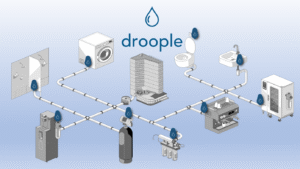
Tele2 IoT × Droople
Case study